
CREATING FROM SCRATCH A PRODUCT THAT DIDN’T EXIST ANYWHERE
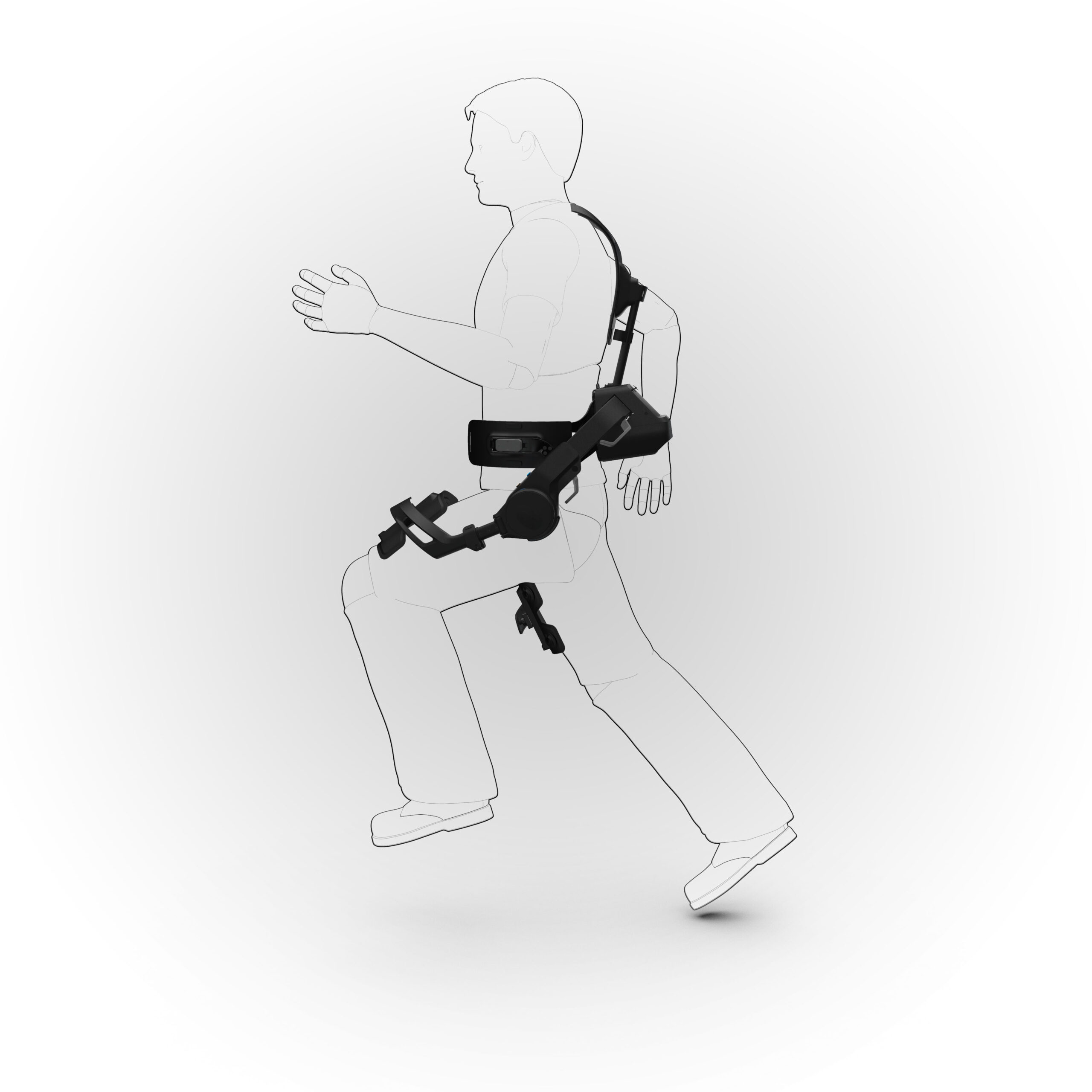
A major French sporting-goods company embarked on an ambitious project: designing a powered exoskeleton capable of assisting hikers in real time, across all types of terrain and for all body types.
Starting from scratch on such a complex product: combining wearable mechanics, embedded electronics, gait algorithms and industrial design, was beyond the resources and expertise available internally.
The company called on Kickmaker to structure and manage the entire innovation programme, from the initial benchmark through to field testing in real mountain conditions.

Our client, a leading brand in the outdoor sector, aims to remove barriers to hiking and explore the uses of tomorrow.
Having observed that certain groups: older people, untrained hikers and people experiencing reduced mobility, struggle to access mountain environments, its innovation teams launched a powered exoskeleton project.
The objective was twofold: to offer a high-performance walking-assistance product and to prepare a new business model based on rental at mountain resorts.
The challenge
Design and validate a consumer-oriented motorized hiking exoskeleton capable of:
- Adapt to a wide range of body types, from 1.55 m to 1.90 m, from S to 2XL
- Preserve natural freedom of movement in all circumstances: squatting, tying shoelaces and taking a side step
- Detect the walking phase in real time: uphill, downhill or flat terrain, to provide assistance at the right moment
- Integrate motors, battery and electronics into a discreet and attractive product
- Guarantee the safety of a system exerting forces directly on the joints
- Enable rapid fitting, compatible with rental use
The solution
Kickmaker structured the project around three complementary technical areas:
1. An Adaptive Mechanical Structure
A portable system designed to fit all body types without ever restricting the body:
- Height and width adjustments to cover the full range of target body types
- Freedom of movement validated in the laboratory before any motorisation
- Mechanical components sized through numerical simulation and validated through destructive physical testing
2. An Intelligent Gait Algorithm
An embedded system capable of analysing and anticipating every movement:
- IMU sensors to locate the user within their walking cycle
- Dynamic adjustment of assistance according to the terrain in real time
- Integration of inverse kinematics for greater responsiveness to unexpected terrain conditions
To ensure performance and reliability, Kickmaker designed a complete electronic system integrating:
- An STM32H7 microcontroller and CAN communication between the actuators
- Simple user interfaces (ON/OFF, assistance levels and battery status)
- An instant assistance deactivation system for safety
- An optimised log-collection architecture for field monitoring
- A Preliminary Risk Analysis compliant with ISO 13849

Benefits
The exoskeleton makes the mountains more accessible by assisting hikers in real time without altering their natural gait.
Tested by 63 hikers over 752 km, 45,000 m of elevation gain and 314 hours in real-world conditions, the product demonstrated its robustness on demanding terrain.
This approach delivered:
- An 80% satisfaction rate during independent 6- to 8-hour hikes—an unprecedented result for our client’s first test
- Discreet, transparent assistance: hikers forgot they were wearing the exoskeleton
- A product that is attractive, functional and discreet
- A unique biomechanical database to support the industrialization phase
This project lays the foundations for a new generation of active portables, with potential applications in rental services, senior assistance and professional mountain environments.
Expertise
Kickmaker supported its client in transforming an exploratory ambition into a viable product, managing the entire programme over three years with 14 engineers.
The teams:
- Conducted a benchmark of existing solutions and a biomechanical study of the walking cycle
- Developed three PoCs and two EVTs through rapid iteration cycles, from the laboratory to alpine terrain
- Designed and validated the gait-detection and motor-assistance algorithm
- Conducted more than 100 morphological fitting sessions with a wide range of user profiles
- Ensured the complete integration of hardware, software and firmware into a single wearable system
- Prepared the industrialisation phase and formalised the lessons learned
By combining multidisciplinary expertise with rapid iteration capabilities, Kickmaker enabled the project to move from a blank sheet of paper to a product tested in real-world conditions, in close collaboration with the client’s internal teams.
Prototypes were produced and validated in the field to prepare for scaling up.
”With Kickmaker, we found a partner capable of covering the entire technical spectrum, from hardware to software, with a real ability to execute in the field. Smooth, fast and practical, that was exactly what we needed.
Head of Innovation